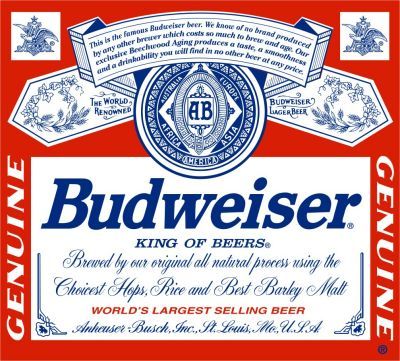
Budweiser

Review Date 9/5/2000 By John Staradumsky
Tonight I'm
sitting down and doing something I haven't done in a long time: sipping a
Budweiser. Ironically, one of the beers I drink least will most likely
generate one of my longest reviews. There are several reasons I don't drink
Budweiser very often. I prefer beers with more flavor to them, but that's a
personal choice. I have always maintained that people have different tastes,
and respect people's choices in what they consume.
Another reason I don't usually drink Budweiser or buy Anheuser-Busch
products is that I have never been happy with their business practices. They
are the biggest guy on the block, and I respect the hard work the company
put into getting there. Still, some of their efforts to retain that position
have been curiously aimed at the smallest of brewers. Several years ago AB
joined with a group of small brewers from Oregon to file a complaint to the
Bureau of Alcohol, Tobacco, and Firearms about contract brewers such as
Boston Beer (Samuel Adams), Miller, and Pete's. Boston Beer and Pete's were
using the facilities of larger brewers to produce their beers regionally.
What AB didn't disclose was that they engaged in the same practice around
the world, contracting out production of Budweiser in various countries.
Another strange policy of AB was that of "100% share of mind". This was a
strategy whereby AB distributors were strongly pressured not to carry beer
brands other than AB's, and many small microbrewers lost business because of
this.
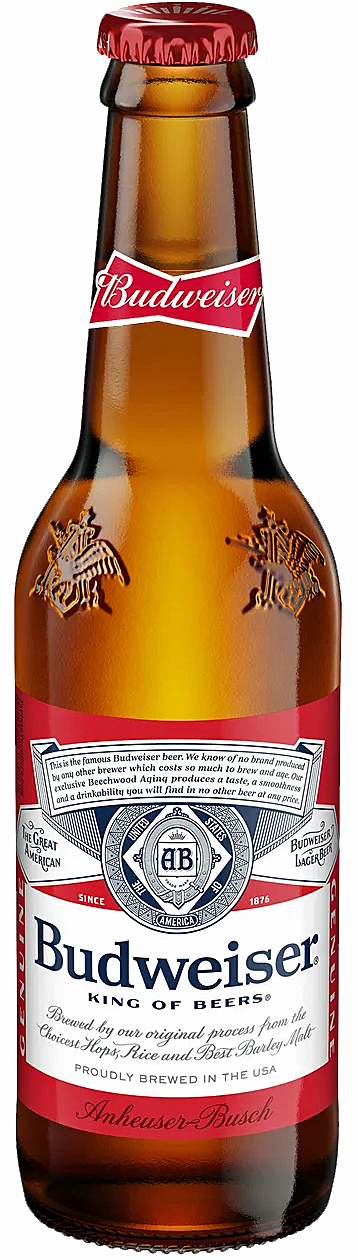
Budweiser has a pale yellow color with a light spritzy head and a thin malt
nose. The palate is relatively clean and crisp, and the colder you drink it
the more that is true. It's a very light beer indeed with just a touch of
malt, which makes it very drinkable in large quantities. If you let the beer
warm up a little though you'll start to notice some interesting things.
First of all, Budweiser has trace amounts of a fermentation product called
acetyldahyde. This comes through of a sort of green apple type character.
You'll also be able to pick up light smooth notes from the rice used to make
this beer milder. Some large brewers use grains besides barley to lighten
their brews. Usually, it's corn. These grains in a beer are called
adjuncts. Finally, you won't find much in the way of hops in Budweiser,
which gives it a rather sweetish finish.
Now to the burning question: why are beers like this so popular? Have the
large breweries fostered these types of brews onto the American public
through evil marketing campaigns? Have Americans' tastes lightened over the
years? Or perhaps is it a combination of factors including both of the
above. I suspect the latter. The move towards lighter, cleaner beers began
in the mid to late nineteenth century with a massive influx of German
immigrants who brought with them a taste for lager beers, a relatively new
arrival to the beer world. In 1876, the relatively new Anheuser-Busch
Brewery of St. Louis, MO introduced Budweiser to the world. The beer was
named after the Czech town of Ceske Budeovice, or Budweis in German (home of
Budweiser Budvar, which was actually first brewed after AB's version). At
the time, most beer sold in the US was local beer, but AB pioneered the use
of refrigerated rail cars to ship their fragile beer nationally, and soon
became a brewer to be reckoned with.
Now we jump ahead to 1919 and the Dark Times known as prohibition. Large
brewers like AB, Coors, and Miller were far better suited to survive
prohibition by making soap, near beer, ceramics, and malted milk than were
small local breweries, many of whom never opened their doors again. This
gave the large brewers and their light lagers an even greater market share
where beer was legalized again in 1933. What's more, during the Second World
War these light lagers were shipped to the troops in Europe and Asia who
developed a taste for them, a taste the large brewers exploited when the
boys came home.
So did the large brewers dumb down our tastes? To a degree. But many signs
point to a general societal preference for lighter tastes. The McDonalds
effect points in that direction too. Fact is, most Americans prefer
Budweiser and lighter beers of this nature. Ultimately, to each individual,
that's all that matters.
Glad I tried it?
 T
T
Would I rebuy it??
*Pricing data accurate at time of review or latest update. For reference only, based on actual price paid by reviewer.
(B)=Bottled, Canned
(D)=Draft
